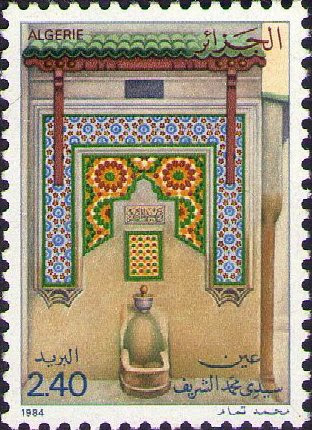
Fountain of Sidi Mohamed Cherif
At the beginning of the 19th century, Algiers had some 150 public fountains.
Places of meeting and popular entertainment, these fountains brought a much appreciated freshness to the city and its inhabitants while allowing passing travelers to quench their thirst.
Many fountains have today disappeared from the familiar landscape of El Djazaïr. However, the remains of these water points still exist and perpetuate the name of the donors who had them erected as so many praises to God and charitable works.
While the tombs are decorated with sculpted steles and the mosques raise their lofty minarets, the fountains offer, to refreshing music, their abundant and clear waters to passers-by for their ritual ablutions before prayer.
Arranged in wall niches, these fountains consist of a small basin leaning against a bare panel or richly decorated either with earthenware or with sculptures elegantly framed by a relief arch.
This set is sometimes leaned against the wall of a building, standing out clearly in front. It is then covered with a platform or a dome. The basin can be sheltered by a vault supported by two or four columns.
All these ancient fountains bear a marble inscription celebrating both its founding, its benefactor, as well as praises to God. If praise is bestowed without reservation on the powerful monarch of the day, devotion does not lose its rights.
These epigraphs are true pieces of calligraphic art. Their beauty is sometimes expressed by the charm of a relief sculpture or by the use of melted lead poured into furrows forming the characters of the text which, by oxidizing in the air, takes on a dark patina which contrasts with the whiteness of the marble.
Both for the historian and the chronicler, these inscriptions are precious documents. This is the case with the Bologhine fountain leaning against the wall of the European cemetery where the Arabic inscription surmounting the fountain continues to recall: “The powerful man animated by sincere intentions with a view to good deeds and noble works – may God enliven his projects in this world and in his final resting place – the very pious lord Mustapha Pasha, governor of Algiers, ordered the construction of this fountain for the purity of its water – Year 1219 (1804-1805 CE).”
Places of meeting and popular entertainment, these fountains brought a much appreciated freshness to the city and its inhabitants while allowing passing travelers to quench their thirst.
Many fountains have today disappeared from the familiar landscape of El Djazaïr. However, the remains of these water points still exist and perpetuate the name of the donors who had them erected as so many praises to God and charitable works.
While the tombs are decorated with sculpted steles and the mosques raise their lofty minarets, the fountains offer, to refreshing music, their abundant and clear waters to passers-by for their ritual ablutions before prayer.
Arranged in wall niches, these fountains consist of a small basin leaning against a bare panel or richly decorated either with earthenware or with sculptures elegantly framed by a relief arch.
This set is sometimes leaned against the wall of a building, standing out clearly in front. It is then covered with a platform or a dome. The basin can be sheltered by a vault supported by two or four columns.
All these ancient fountains bear a marble inscription celebrating both its founding, its benefactor, as well as praises to God. If praise is bestowed without reservation on the powerful monarch of the day, devotion does not lose its rights.
These epigraphs are true pieces of calligraphic art. Their beauty is sometimes expressed by the charm of a relief sculpture or by the use of melted lead poured into furrows forming the characters of the text which, by oxidizing in the air, takes on a dark patina which contrasts with the whiteness of the marble.
Both for the historian and the chronicler, these inscriptions are precious documents. This is the case with the Bologhine fountain leaning against the wall of the European cemetery where the Arabic inscription surmounting the fountain continues to recall: “The powerful man animated by sincere intentions with a view to good deeds and noble works – may God enliven his projects in this world and in his final resting place – the very pious lord Mustapha Pasha, governor of Algiers, ordered the construction of this fountain for the purity of its water – Year 1219 (1804-1805 CE).”