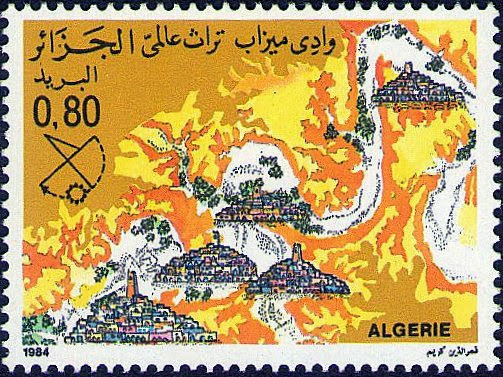
The M'zab valley - part of the world heritage
A jewel of traditional architecture, the M'zab valley, which had been the subject of national protection and conservation measures, notably through the creation of a study and restoration workshop and classification among historic sites, saw its prestige crowned by its inscription on the UNESCO world heritage list in 1982.
It is in a desert and arid landscape, at the gates of the Sahara, 600 km south of Algiers, that the Ibadites, fleeing their Rostemide kingdom after the fire of Tahert around 909 and after a precarious settlement in Sedrata (Ouargla), settled at the beginning of the 11th century in M'zab, named after the river which crosses this fossil valley.
The choice of this valley is explained above all by the defense possibilities it offered to a community concerned about its security and determined to safeguard its identity.
The necessities of survival and adaptation to an inhospitable land forced the Ibadites to occupy the land and organize the space inspired by very strict principles of community conduct.
Five ksour (fortified villages), El Ateuf, Bounoura, Béni Izguen, Melika and Ghardaïa, located on rocky outcrops, bring together a sedentary and essentially urban population.
Each of these small cities, surrounded by a rampart, is dominated by a mosque whose minaret serves as a spiritual and temporal center.
Around this building, essential to community life, there are houses arranged in concentric circles up to the surrounding wall.
Each house constitutes a cubic cell, illustrating an egalitarian social organization based on respect for the family structure, the intimacy and autonomy of which it strives to preserve.
This region where these refugees have chosen to settle has no spring, the wadi only flows occasionally once or twice a year and the water table is 40 m and sometimes 100 m from the surface.
All the efforts of the community had to be devoted to tasks related to agriculture: creation of the oasis, domestication of water through dams or hill reservoirs, drilling, irrigation wells.
The constructions were designed on the sole criterion of efficiency. The elements of support points, the walls, the roofs were arranged without conventional or preconceived formalism.
The use of local materials combined with the simplicity of forms and manual techniques under the sign of economy and rigor make the smallest wall a lesson in modern architecture.
Everything is on a human scale; the ramparts are within earshot of the muezzin, the arch of the vault is the size of the palm, the coating of the wall sculpted by the hand of the mason.
Each construction element is subordinated to the gestures of daily life. Streets are quite comparable to corridors; often covered with vaults, they offer pedestrians shade and coolness.
The M'zab thus carries out in the most spontaneous manner the task that modern town planning sets itself, often unsuccessfully: the beautiful and the functional, which are no longer two contradictory criteria, or difficult to reconcile, are combined in these constructions which exactly follow the rhythms of life.
It is in a desert and arid landscape, at the gates of the Sahara, 600 km south of Algiers, that the Ibadites, fleeing their Rostemide kingdom after the fire of Tahert around 909 and after a precarious settlement in Sedrata (Ouargla), settled at the beginning of the 11th century in M'zab, named after the river which crosses this fossil valley.
The choice of this valley is explained above all by the defense possibilities it offered to a community concerned about its security and determined to safeguard its identity.
The necessities of survival and adaptation to an inhospitable land forced the Ibadites to occupy the land and organize the space inspired by very strict principles of community conduct.
Five ksour (fortified villages), El Ateuf, Bounoura, Béni Izguen, Melika and Ghardaïa, located on rocky outcrops, bring together a sedentary and essentially urban population.
Each of these small cities, surrounded by a rampart, is dominated by a mosque whose minaret serves as a spiritual and temporal center.
Around this building, essential to community life, there are houses arranged in concentric circles up to the surrounding wall.
Each house constitutes a cubic cell, illustrating an egalitarian social organization based on respect for the family structure, the intimacy and autonomy of which it strives to preserve.
This region where these refugees have chosen to settle has no spring, the wadi only flows occasionally once or twice a year and the water table is 40 m and sometimes 100 m from the surface.
All the efforts of the community had to be devoted to tasks related to agriculture: creation of the oasis, domestication of water through dams or hill reservoirs, drilling, irrigation wells.
The constructions were designed on the sole criterion of efficiency. The elements of support points, the walls, the roofs were arranged without conventional or preconceived formalism.
The use of local materials combined with the simplicity of forms and manual techniques under the sign of economy and rigor make the smallest wall a lesson in modern architecture.
Everything is on a human scale; the ramparts are within earshot of the muezzin, the arch of the vault is the size of the palm, the coating of the wall sculpted by the hand of the mason.
Each construction element is subordinated to the gestures of daily life. Streets are quite comparable to corridors; often covered with vaults, they offer pedestrians shade and coolness.
The M'zab thus carries out in the most spontaneous manner the task that modern town planning sets itself, often unsuccessfully: the beautiful and the functional, which are no longer two contradictory criteria, or difficult to reconcile, are combined in these constructions which exactly follow the rhythms of life.