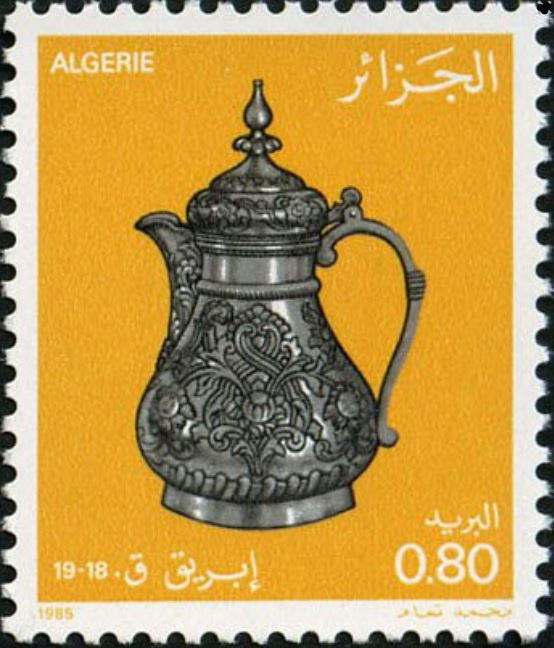
Teapot from the 18th and 19th centuries
In practically all Algerian towns and countryside, the “rue des Siyyaghine” (rue des goldsmiths) is part of the environment and represents a particular district in terms of its shops, its artisans and the atmosphere that reigns there.
The shops are similar and all occupy a small area. The goldsmith works there seated to the rhythm of the small blows of the hammer and the friction of the file.
For a long time, despite the value of the objects he produced and the material he used, the goldsmith used a basic installation composed of a hearth made up of several stones stacked on top of each other and a crucible made of refractory earth to melt the gold and silver. As a mold, a cuttlefish bone was used to cast the jewelry in a single piece.
The goldsmith had a limited range of tools: the hammer which, handled skillfully, produced wonders, and the anvil. It was between a hammer and a hard place that the jewel was created. The stylus to trace the patterns, the drill to drill, the pincers, the file and the chisel finished the work under the patient and precise guidance of the goldsmith.
The everyday objects found in homes were the very expression of refinement in urban society, while the utensils took on the appearance of luxury ornaments that decorated the homes while delighting the guest to whom the most beautiful coffee or teapots, the most beautiful cups and the most beautiful trays were displayed.
The house exhaled the best scents of incense which burned in censers or openwork perfume burners to reveal a metal chiseled by the skillful hands of experienced craftsmen.
The shops are similar and all occupy a small area. The goldsmith works there seated to the rhythm of the small blows of the hammer and the friction of the file.
For a long time, despite the value of the objects he produced and the material he used, the goldsmith used a basic installation composed of a hearth made up of several stones stacked on top of each other and a crucible made of refractory earth to melt the gold and silver. As a mold, a cuttlefish bone was used to cast the jewelry in a single piece.
The goldsmith had a limited range of tools: the hammer which, handled skillfully, produced wonders, and the anvil. It was between a hammer and a hard place that the jewel was created. The stylus to trace the patterns, the drill to drill, the pincers, the file and the chisel finished the work under the patient and precise guidance of the goldsmith.
The everyday objects found in homes were the very expression of refinement in urban society, while the utensils took on the appearance of luxury ornaments that decorated the homes while delighting the guest to whom the most beautiful coffee or teapots, the most beautiful cups and the most beautiful trays were displayed.
The house exhaled the best scents of incense which burned in censers or openwork perfume burners to reveal a metal chiseled by the skillful hands of experienced craftsmen.