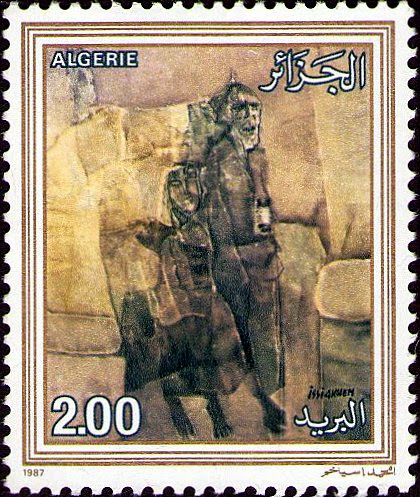
The Blind M'Hammed Issiakhem
M’hamed Issiakhem was born in June 1928 near Azeffoun, in Greater Kabylia. He spent his early childhood in Relizane and in 1943, while still a child, his left arm was amputated following the accidental handling of a grenade. This tragedy, during which he lost three members of his family, will reverberate many years later and will indirectly decide his future.
From 1947, he followed the courses of the Society of Fine Arts of Algiers then, until 1951, those of the School of Fine Arts of Algiers in the company of Mesli and Louaïl. From 1951 to 1953, there was what we can call Issiakhem’s Parisian period. During these years, he frequented the Legueult workshop. He was then attracted by art brut and Jean Dubuffet, but also by abstract art. The landscape preserved at the National Museum of Fine Arts bears witness to this penchant. The plastic experience acquired during this period will remain essential.
In 1962, he obtained a scholarship to Casa Vélasquez in Madrid, but he chose to return to Algeria. In 1963, he began his national and international career and participated in all major exhibitions of Algerian art abroad and in the artistic life of our country. A founding member of the National Union of Plastic Arts, he works as a press cartoonist and creates banknotes, posters, as well as postage stamps.
In 1973, he won the gold medal at the Algiers International Fair and in 1980, he received the first Golden Simba from Rome, a UNESCO distinction for African art.
In 1982 and 1984, M’hamed Issiakhem organized two retrospectives of his work. He died in December 1985 following a long illness. Throughout his career, M’hamed Issiakhem primarily expresses the pain and suffering of human beings. His entire work bears witness to the critical look, sometimes laden with a certain bitterness, that he casts on the human condition. This lucidity will be maintained by his personal pain which he will project even in his last works.
From 1947, he followed the courses of the Society of Fine Arts of Algiers then, until 1951, those of the School of Fine Arts of Algiers in the company of Mesli and Louaïl. From 1951 to 1953, there was what we can call Issiakhem’s Parisian period. During these years, he frequented the Legueult workshop. He was then attracted by art brut and Jean Dubuffet, but also by abstract art. The landscape preserved at the National Museum of Fine Arts bears witness to this penchant. The plastic experience acquired during this period will remain essential.
In 1962, he obtained a scholarship to Casa Vélasquez in Madrid, but he chose to return to Algeria. In 1963, he began his national and international career and participated in all major exhibitions of Algerian art abroad and in the artistic life of our country. A founding member of the National Union of Plastic Arts, he works as a press cartoonist and creates banknotes, posters, as well as postage stamps.
In 1973, he won the gold medal at the Algiers International Fair and in 1980, he received the first Golden Simba from Rome, a UNESCO distinction for African art.
In 1982 and 1984, M’hamed Issiakhem organized two retrospectives of his work. He died in December 1985 following a long illness. Throughout his career, M’hamed Issiakhem primarily expresses the pain and suffering of human beings. His entire work bears witness to the critical look, sometimes laden with a certain bitterness, that he casts on the human condition. This lucidity will be maintained by his personal pain which he will project even in his last works.