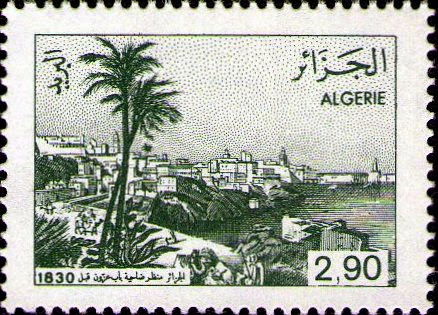
View of Algiers View of Bab-Azzoun before 1830
The Djamaâ Djedid mosque was built in 1660 on the site of the Bou Annan madrasa. It was intended to be the largest mosque in El Djazaïr at a time when each corporation and each neighborhood had its small mosque. Following the official mosque model decreed by the Zirid king Abu Abdallah Mohamed II (1505-1512), it was built in the shape of a cross, like many Turkish mosques which wanted to distinguish themselves from other styles.
It was the mosque of the Turkish militia dispatched by the Ottoman Empire to serve the Regency of Algiers. Dedicated to worship following the Hanefite rite which was current among the Turks, this mosque was built by fishermen according to the Anatolian architectural style of the mosques of Istanbul: a plan in the shape of a Latin cross, an ovoid-shaped dome ending in a point and surrounded by four smaller domes.
Immaculate white, like that of the houses and buildings of Algiers, its minaret is square in shape and whose initial height was around 40 m, but which was reduced to 27 m with the construction, by the French colonizer, of the Boulevard de la République, Che Guevara currently.
Since 1853, it is on this minaret that the Algiers clock has hung, while it was in the Djenina palace. The minbar of Djamaâ Djedid is Italian style, in sculpted marble. For several centuries, imams and faithful took turns using a precious manuscript of the Koran which, today, is kept at the National Museum of Antiquities.
Vault of the Admiralty Djamaâ Djedid overlooks one of the gates of the old fortress, Bab El B'har (sea gate), which leads to the Admiralty, once famous for its vault from which the goods of Christian traders subject to customs taxes entered. It was the gate for guests and foreign sailors. As for the natives coming from Mitidja and Kabylia, their access door was Bab Azzoun, to the south of the city, and which owes its name to Azzoun, condemned to death by the Regency and executed by impalement on a hook fixed above the door.
It was the mosque of the Turkish militia dispatched by the Ottoman Empire to serve the Regency of Algiers. Dedicated to worship following the Hanefite rite which was current among the Turks, this mosque was built by fishermen according to the Anatolian architectural style of the mosques of Istanbul: a plan in the shape of a Latin cross, an ovoid-shaped dome ending in a point and surrounded by four smaller domes.
Immaculate white, like that of the houses and buildings of Algiers, its minaret is square in shape and whose initial height was around 40 m, but which was reduced to 27 m with the construction, by the French colonizer, of the Boulevard de la République, Che Guevara currently.
Since 1853, it is on this minaret that the Algiers clock has hung, while it was in the Djenina palace. The minbar of Djamaâ Djedid is Italian style, in sculpted marble. For several centuries, imams and faithful took turns using a precious manuscript of the Koran which, today, is kept at the National Museum of Antiquities.
Vault of the Admiralty Djamaâ Djedid overlooks one of the gates of the old fortress, Bab El B'har (sea gate), which leads to the Admiralty, once famous for its vault from which the goods of Christian traders subject to customs taxes entered. It was the gate for guests and foreign sailors. As for the natives coming from Mitidja and Kabylia, their access door was Bab Azzoun, to the south of the city, and which owes its name to Azzoun, condemned to death by the Regency and executed by impalement on a hook fixed above the door.