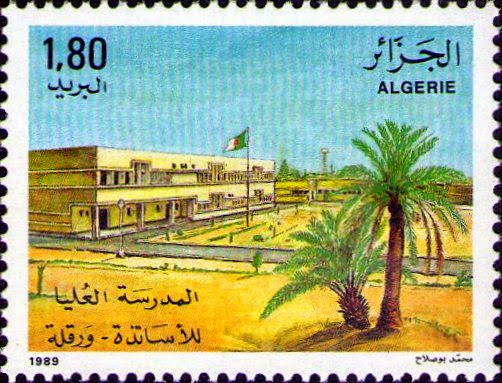
Ouargla Higher Normal School
Providing the southern regions with the means to ensure their economic, social and cultural development is part of the policy initiated by the public authorities at the start of the 1980s. A year ago, the wilaya of Ouargla was equipped with a Higher Normal School. The new higher school specializing in teacher training has the mission of filling a void in terms of supervision at the high school level. 139 students registered at the start of the 1987-1988 academic year for a four-year course of study to obtain a bachelor's degree in exact sciences in the fields of physics, chemistry and mathematics.
The wealth of oasis areas and the potential they represent in terms of agricultural production are an undeniable fact. In the desert climate, a single tree can defy the sun. This is the date palm. Pheniciculture, generally made up of small family farms, allows not only the production of dates, but also the cultivation of other crops by creating a microclimate.
Arboriculture and market gardening, intended exclusively for local consumption, are living examples that allow us to believe in the possibility of perennial crops in the Saharan zones. The exploitation of the Albian aquifer has enabled the development of cereal crops in the Adrar region. With a depth that can exceed several hundred meters, the aquifer extends to In Amenas, passing through In Salah, and gradually sinks towards the north.
Oil and gas exploitation is at the center of the priorities of the Algerian authorities. Hassi R’mel, the heart of gas production, is an invaluable provider of wealth. The deposit was discovered in 1956. It is the largest natural gas deposit on the African continent. It was from 1976 that Algeria began to develop its Hassi R’mel gas processing infrastructure.
The wealth of oasis areas and the potential they represent in terms of agricultural production are an undeniable fact. In the desert climate, a single tree can defy the sun. This is the date palm. Pheniciculture, generally made up of small family farms, allows not only the production of dates, but also the cultivation of other crops by creating a microclimate.
Arboriculture and market gardening, intended exclusively for local consumption, are living examples that allow us to believe in the possibility of perennial crops in the Saharan zones. The exploitation of the Albian aquifer has enabled the development of cereal crops in the Adrar region. With a depth that can exceed several hundred meters, the aquifer extends to In Amenas, passing through In Salah, and gradually sinks towards the north.
Oil and gas exploitation is at the center of the priorities of the Algerian authorities. Hassi R’mel, the heart of gas production, is an invaluable provider of wealth. The deposit was discovered in 1956. It is the largest natural gas deposit on the African continent. It was from 1976 that Algeria began to develop its Hassi R’mel gas processing infrastructure.