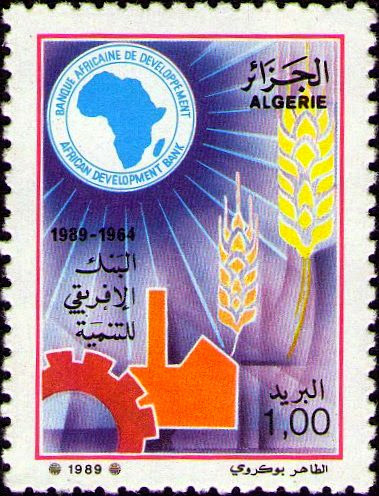
25th Anniversary of the African Development Bank ADB
During the 1980s, most African countries adopted rigorous programs of structural adjustment and monetary liberalization. The expectation was that by unleashing market forces and making the private sector the engine of growth while the state assumes a constructive facilitating role, we would launch the continent on the path to new, stable and long-term growth.
Since its creation, the African Development Bank has had to work in a rather difficult economic situation and has fully deserved to be the great multilateral institution of Africa. The Bank was established in 1963 by 33 African nations in Khartoum (Sudan) during the Conference of African Ministers of Finance which approved the text of the agreement establishing the African Development Bank (AfDB), which entered into force on September 10, 1964.
The founders wanted this autonomous multilateral bank. Algeria, a founding member, originally held 1.16% of the amount of the subscribed capital of this institution. Its activities got off to a very slow start: loan approvals averaged only $21 million per year during the period from 1970 to 1972.
The Group's “concessional” window – the African Development Fund (or ADF) – began operations in 1973, thanks to a donation of $82 million from 13 non-regional members and the AfDB. The Fund, having a separate administration, granted 50% of the votes to non-regional members. But in the meantime, the Bank saw its paid-up capital barely increase during the 1970s, and it finally accepted members from outside the region in 1982, although limiting them to a third of the seats on the Board of Governors. Loan approvals then spiked sharply.
Since its creation, the African Development Bank has had to work in a rather difficult economic situation and has fully deserved to be the great multilateral institution of Africa. The Bank was established in 1963 by 33 African nations in Khartoum (Sudan) during the Conference of African Ministers of Finance which approved the text of the agreement establishing the African Development Bank (AfDB), which entered into force on September 10, 1964.
The founders wanted this autonomous multilateral bank. Algeria, a founding member, originally held 1.16% of the amount of the subscribed capital of this institution. Its activities got off to a very slow start: loan approvals averaged only $21 million per year during the period from 1970 to 1972.
The Group's “concessional” window – the African Development Fund (or ADF) – began operations in 1973, thanks to a donation of $82 million from 13 non-regional members and the AfDB. The Fund, having a separate administration, granted 50% of the votes to non-regional members. But in the meantime, the Bank saw its paid-up capital barely increase during the 1970s, and it finally accepted members from outside the region in 1982, although limiting them to a third of the seats on the Board of Governors. Loan approvals then spiked sharply.