Welcome to Algeria Stamps
A historic collection of 1,730 Algeria postage stamps

✨ Discovery of the day
Year: 2002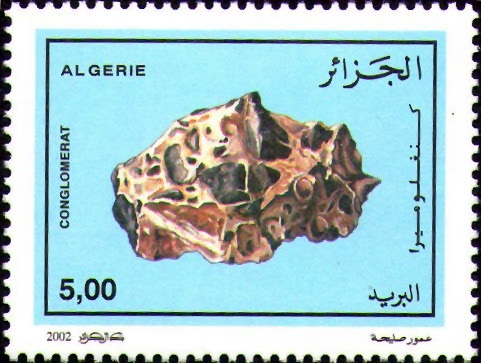
Conglomerate
Miocene conglomerate containing Jurassic limestone-Moustiers-Sainte-Marie. In petrography, a conglomerate is a detrital rock (resulting from the mechanical degradation of other rocks) composed of pieces linked together by natural cement. To be considered discernible, the pieces must measure more than 2 mm (below this size, we would be dealing with a sandstone and no longer a conglomerate). Conglomerates are most often sedimentary in nature, but they can also be volcanic. Among the conglomerates, we find: - the breccias, composed of angular blocks; - puddingues, made up of rounded pebbles; - and tillites which contain both angular pebbles and rounded pebbles. Many conglomerates were formed when the sea invaded a originally continental surface (transgression), in a low area. Sparnacien pudding from Nemours south of Fontainebleau We call ossiferous conglomerate a conglomerate rich in bones of reptiles, birds and mammals: example of the conglomerates of the lower tertiary discovered at Meudon in 1836
View Stamp Details →Collection Gallery

The Higher Youth Council

The 75th anniversary of the Palestinian Nakba

Chouhada without graves

The Parliamentary Union of OIC Member States (PUIC)

First Budget Program

Expo 2020, Dubai 2021- Algeria Pavilion

Diplomatic relations between Algeria and Cuba

World Post Day

6th General Population and Housing Census

League of Arab Countries

60th anniversary of independence 1962 - 2022

National Day of Memory

World Expo Dubai 2020

Independence Day

Let's eat Algerian